


Motor Pulse Width Modulator Regulator PWM Governor 20A 1,200W Model NFP-PWM-DC9-60V
$10.00
Take charge of your low-voltage projects with the versatile dc motor speed controller. It enables smooth speed and direction management. Get it today!
12V 24V 30V Brush Motor Driver Control Module Data Sheet
Product Overview
The NFP-PWM-DC9-60V is a DC brush motor speed controller for 9V to 60V DC input. Therefore, it can support many low-voltage DC motor control projects.
In addition, this module supports forward and reverse switching. As a result, users can control motor direction more easily.
Moreover, the integrated knob allows stepless speed control from 0% to 100%. Therefore, users can adjust motor speed based on load, noise, and working condition.
Main Features
- Forward and reverse switching: Users can change motor direction with the integrated switch. Therefore, this controller fits two-way DC motor systems.
- Stepless speed control: The knob adjusts speed from 0% to 100%. As a result, users can fine-tune motor output.
- Wide input voltage: The module supports 9V to 60V DC input. In addition, it can work with 12V, 24V, 30V, and other DC systems within range.
- High output current: The controller supports 0 to 20A output current. However, users should keep long-term operation within 10A.
- 25KHz PWM frequency: The controller uses PWM speed control. Therefore, it can provide smooth motor speed adjustment.
Technical Specifications
The table below shows the main controller data. Therefore, users can check current, voltage, speed range, PWM frequency, power limit, control mode, phase number, and weight before wiring.
| Model | NFP-PWM-DC9-60V |
|---|---|
| Output Current | 0 – 20A |
| Input Voltage | 9V – 60V DC |
| Speed Range | 0% – 100% |
| Speed Regulation | Stepless |
| PWM Frequency | 25KHz |
| Power Limit | 1,200W |
| Speed Regulation Mode | Potentiometer (linear) |
| Phase Number | 2 phases |
| Weight | 155g |
DC Motor Speed Controller Speed Switch Module Usage
Safety Warning
Please check the positive and negative poles before power-on. Otherwise, wrong polarity may damage the controller or motor.
In addition, keep the module in open air during long-term use. As a result, the controller can release heat more safely.
- Do not reverse polarity: Connect positive and negative wires correctly. Therefore, always check wiring before power-on.
- Do not connect signal wires incorrectly: Wrong signal wiring may damage the module.
- Use within 10A for long-term operation: The controller supports higher current, but long-term use should stay within 10A.
- Keep good heat dissipation: Leave enough airflow around the module. In addition, do not cover the heat area.
- Do not connect 220V AC: This controller only supports DC input from 9V to 60V.
- Do not use it in electric cars: Use this controller only for suitable small DC motor applications.
- Do not stall the motor: Do not block the shaft. Otherwise, the motor or gearbox may fail.
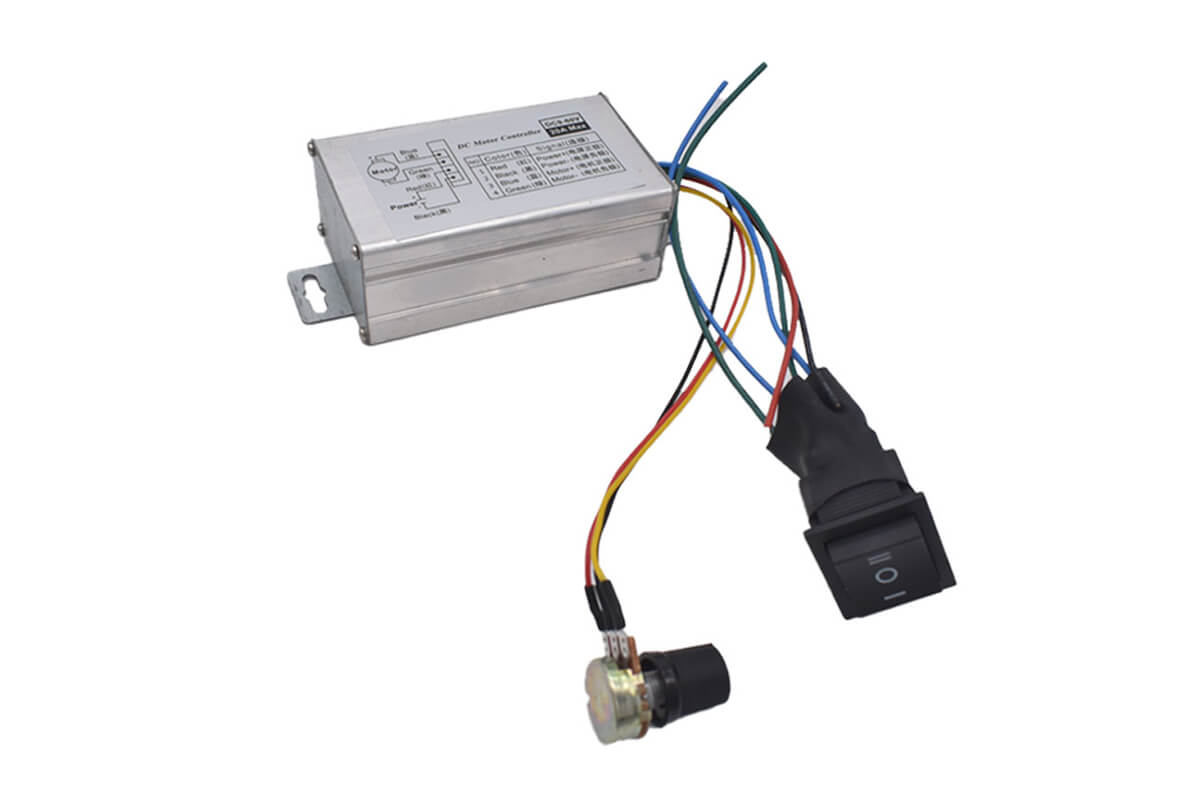
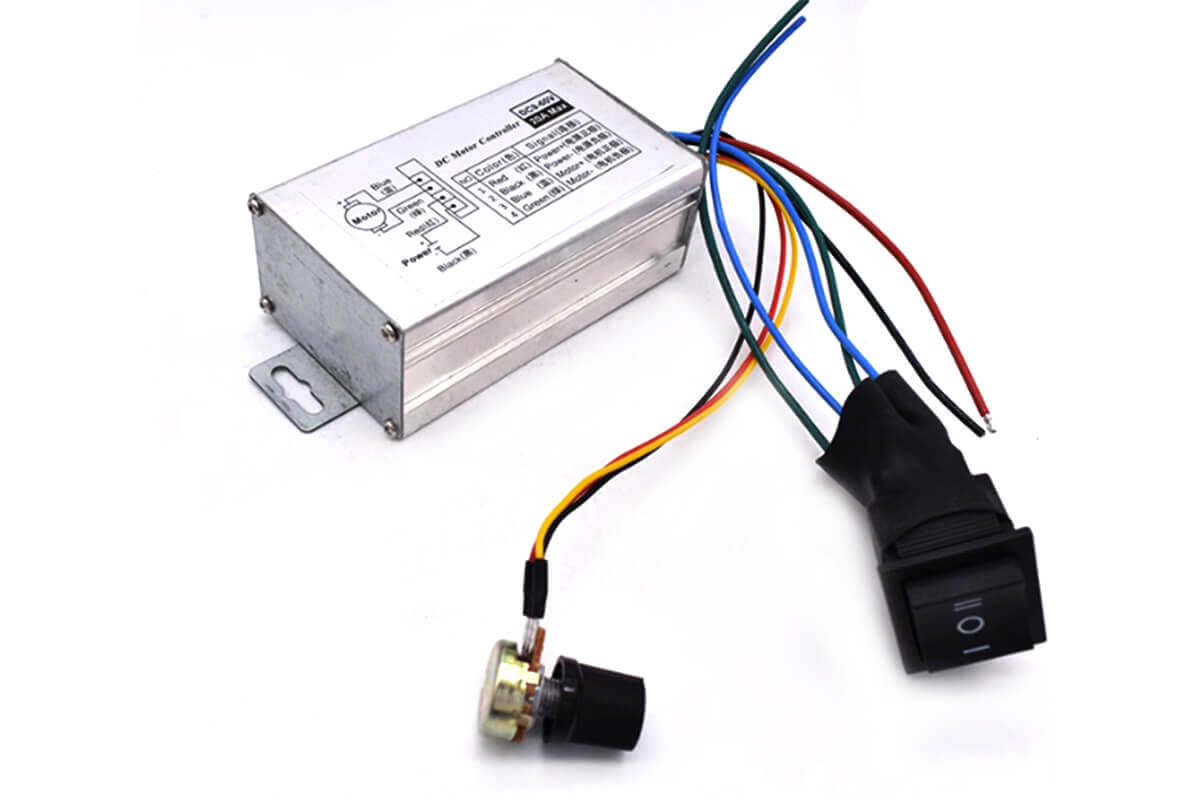
Controller Module Image
The image below shows the DC motor controller module. Therefore, users can check the knob, switch, and wiring terminals before installation.

Motor Speed Control Regulator With Switch & Knob Wiring Diagram
Why DC Motor Speed Control Is Important
DC motor speed control helps users match motor output with the actual load. Therefore, the motor can run more smoothly and safely.
In addition, speed control can reduce power use when the system does not need full output. As a result, users can reduce heat, noise, and operating cost.
Energy Saving Benefits
When a system needs less power, users can slow down the motor. Therefore, the controller can help reduce energy use.
Moreover, lower power use can reduce heat. As a result, the motor and controller may run more safely under proper load.
Load Control Benefits
Many systems face changing load conditions. Therefore, adjustable speed helps users match motor speed with each working condition.
In addition, stable speed control can improve system operation. As a result, the motor can run with better consistency.
Motor Life and Noise Benefits
Running a motor at high speed for a long time can increase wear. Therefore, speed control helps users keep the motor within a safer speed range.
In addition, high speed can create more noise. As a result, users can reduce sound by lowering the motor speed when full speed is not needed.
Motion Control Benefits
Smooth acceleration and deceleration can improve user comfort in lift, door, or motion systems. Therefore, speed control matters in many motion products.
Moreover, fast speed adjustment helps robots and automated systems respond more quickly. As a result, users can improve dynamic control performance.
Main Benefits of Speed Control
- Energy saving: Lower speed can reduce power use when the load is light. Therefore, the system can work more efficiently.
- Stable load control: Adjustable speed helps match changing load conditions. As a result, operation becomes more stable.
- Longer motor life: Lower speed can reduce wear. Therefore, users can protect the motor during long-term operation.
- Lower noise: Slower motor speed can reduce running sound. In addition, it can improve user experience.
- Smoother motion: Controlled speed changes help improve acceleration and deceleration.
- Better response: Quick speed adjustment helps robotics and automation systems respond faster.
Wiring Diagram
The wiring diagram below shows the 12V DC motor speed controller circuit connection. Therefore, users should check input power, motor output, and switch direction before testing.
Moreover, correct wiring helps protect the controller and motor. However, users should not power the module until all terminals are confirmed.

Selection Notes
- For 12V motors: Use a stable 12V DC power supply with enough current capacity.
- For 24V motors: Use a 24V DC power supply. In addition, confirm that motor current stays within a safe range.
- For 30V systems: Make sure the input voltage stays within the 9V to 60V DC range.
- For high current use: Check heat dissipation carefully. Moreover, add airflow when the current is high.
- For gear motors: Avoid shaft stall. Therefore, leave enough torque margin in the design.
Keywords:
12 voltage regulator, electric motor speed controller, low voltage motor speed controller
1.Payment methods : Paypal, T/T
Shipping:
1.Delivery: DHL/FedEx 3-5 days.
2.Item will be shipped within 1-3 business days after the payment.
3.If you haven’t received the item on the Delivery Time, pls contact us by email if you have any questions. Normally, we will give you a reply within 24 hours, if not, pls check the spam of your email box. We will do our best to help you solve the problems.
4.Please make sure your address is matched with the finally shipping address before you pay.
FAQ
Q: If customized, what information should you provide?
A: You need to provide the basic specification of the motor, such as: Dimensions, Sizes Applications, Voltage, Speed and Torque. It’s better to offer application prototype drawings to us if possible.
Q: What’s your main motors?
A: Diameter 4mm~42mm Dc Micro Motor And Gear Motor, Auto Dc Motor, Electric Motor, Gear Motor, Mini Dc Motor, Brush Dc Motor, Brushless Dc Motor, Spur Gear Motor, Micro Motor, Vibration Motor Etc.
Q: What’s the main application of the micro dc motor?
A: Our mini DC motors are widely used in Home Applications, Office Equipment, Health-Care Application, Sanitation Industry, High-Class Toy, Banking System, Electronic and Electrical Tools, Automation Industry, Bank Equipments, Payment Equipments, Vending Machines, Power Door Lock, Electric Door Lock.
Free Shipping Site-wide When You Spend More Than $150
Related products
-

Brushless Motor Controller with Stepless Speed 3650, 3525, 2430, 2418 Series 3-Phase Motor Model NFP-PWM-BLDC-3650
Add to cart -
200W 10A 6V-24V Brushless BLDC Motor Driver Board Model NFP-BMLC-255A
Add to cart -
Motor Driver Module DC 3V-60V 12V 24V PWM Controller Model NFP-PWM-CCM6N
Add to cart -
DC Motor Speed Controller Compatible with 12V 24V 36V 48V Motor Model NFP-PWM-CCM6DS
Add to cart
Reviews